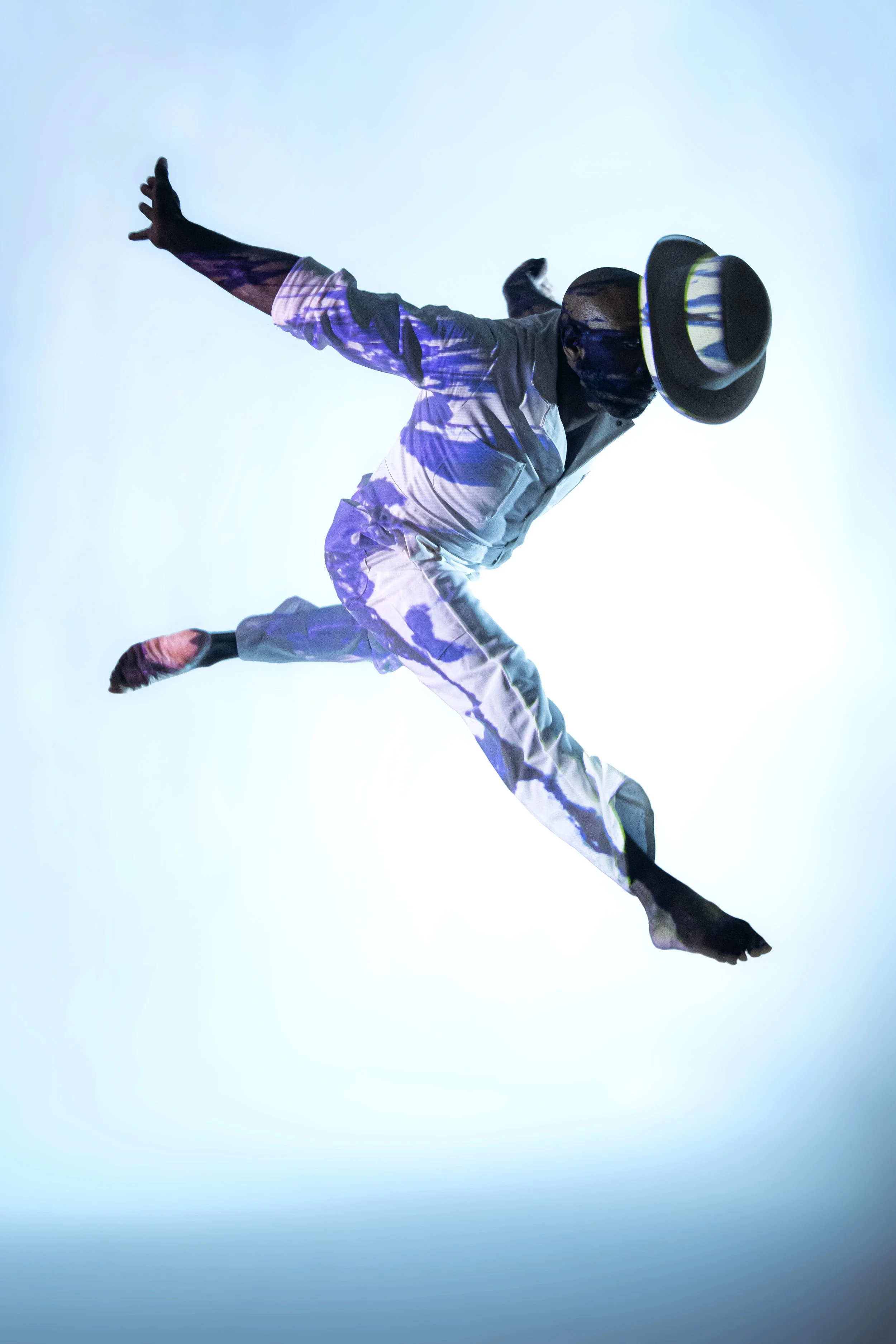
Dance Center Artistic Director Meredith Sutton spoke with The Seldoms’ Founding Artistic Director Carrie Hanson about the long-awaited Chicago premiere of Floe coming to the Dance Center March 12 - 13, 2026.
Meredith: I want to dig right in on context and place about this Chicago premiere. What does it mean to you to bring this work home, given The Seldoms’ deep, integral role in Chicago's dance ecosystem?
Carrie: I have a long history with the Dance Center—I've taught here since 1999, even before we moved to the current building. It’s always a pleasure to bring The Seldoms work to the Dance Center because it's my home base and I think the theater is one of the best in the city. Our work tends to be multimedia. Floe has strong visuals and the Dance Center’s space can showcase them beautifully.
Meredith: Agreed!
Carrie: We actually started making this piece back in 2018. It was a juicy, deep process, and we had several production and creative residencies. We had the opportunity to premiere it at UW-Madison’s Union Theater, and then everything shut down in March 2020 because of Covid, and the Chicago premiere had to be postponed. I've been waiting for the right moment to bring this piece back. The Dance Center feels like the right venue, in part because the stage is big enough to hold these two large inflatable icebergs; also, it's a dance theatre piece and because there's so much spoken word, you need to feel a proximity to the performers, which we’ll have at The Dance Center.
Meredith: Of course we are biased, but there's something delicious about that proximity of performer and observer.
Carrie: We’re currently working with Brian Shaw, a longtime theatre faculty member here. Brian has helped The Seldoms in previous projects with delivery of spoken word. My dancers are fantastic movers and technicians—speaking is not their primary performance language. Brian has been coming into rehearsals and expanding their comfort levels and abilities. Another theatre faculty member involved in the project is Mikhail Fiksel.
Meredith: That's amazing that there's so many artistic collaborators from Columbia that are involved in this work.
Carrie: Misha has also worked with us for more than a decade. He’s a Tony Award-winning sound designer and composer. His sound design for Floe is quite extraordinary. He used field recordings, sounds of glacial melt, ocean, wind, seagulls. It’s quite riveting.
Meredith: Floe joins a larger body of work that you've been making for the company surrounding environmental change and how pertinent research is to your process. How did climate change research influence your approach to the choreography for this work?
Carrie: We always work hard to have the choreography convey the subject matter. And that kind of invention comes out of a real physical state, or a physical situation of risk, or environmental grief. It is essential to delivering this subject matter. For me, the problems of environmental degradation, of climate change, and everything that will accompany that and who that will fall upon are the most urgent. In rehearsal, I’m talking to the dancers about the things they are fired up about that are happening around us in our world. How does that inform your physicality? How does that change the way you touch another dancer? How does it change the way you do this particular phrase? We have to see that.
Meredith: That makes me connect to our overarching view for the season at the Dance Center. What does the present moment indicate and how is that inspiring the way we're moving through or inspiring change in this moment? It also makes me recall something I read where you described the body as being the center of gravity of this crisis. Talk more about that. I find that so interesting.
Carrie: When we went to Houston at the invitation of Diverseworks and the Rothko Chapel, they helped us meet and interview people, people whose homes had flooded from Hurricane Harvey, a civilian rescuer, a climate activist, an environmental lawyer. We did a work-in-progress performance followed by a conversation with the audience. People were eager to talk about their experiences—not just the hurricane itself, but the rain that accompanied it and lasted for days—historic, record-breaking weather events. We listened to them talk about going out in a kayak, floating over their mailbox, pulling down all of the wet drywall for weeks afterward, how torn up their hands were. Initially, as part of the sound design, there was rainfall but our presenter strongly recommended we omit that, as sounds of rain triggered lingering trauma and fear in their bodies. It lived there still. I think when we talk about climate change, when we read about climate change, it seems abstract at some level. It's not, because we're seeing all of these changes from fires to floods to melting ice, but I think we need to understand it more as a physical experience.
Meredith: Can you speak more about how the dancers served as a point of collaboration as you were creating this work?
Carrie: This material has a kind of muscularity to it—a lot of The Seldoms’ work does— that is intended to express the problem-solving nature of the effort: How do we move through this, how do we get through this, how do we survive? One of the references for this work was Moby Dick. I saw the connection because Moby Dick is this story about a kind of madness, right? An ill-fated battle of man’s attempt to try and conquer nature, which is futile. I assigned the dancers chapters about Captain Ahab to get at that physical kind of madness. At some point, Ahab knew that the battle was lost but kept forging ahead anyway. There's another reference that became a choreographic motif. “Monkey-roping” was a whaling technique in which the whalers are tethered together by ropes around their waists to avoid the one falling from a slippery whale carcass. We designed material that had the dancers constantly connected, using their arms to rope, tie and untie. Interconnectivity became one of the working ideas. Not only interconnectivity between all of us, but us inside of an ecosystem—too often we forget that. I always like to work with proximity and partnering a lot and it deepened our sensitivity about how to make contact with one another.
Meredith: It's scale, it's intention, it's proximity. What of kind of thinking or rethinking do you hope will ignite audiences from experiencing Floe?
Carrie: I'm aware that we’re often preaching to the choir. And it’s funny because there's some preaching that actually happens in this work. Damon Green appears a few times as another character from Moby Dick, Father Mapple, sermonizing. So people coming to Floe are going to go to church a little bit, whether they want to or not! The challenge always is how does the performance actually sit? How can it become a platform for more conversation, more action, or even some action? I've been thinking about this for years. When we did the premiere at Union Theater, we had activists come from a nonprofit climate organization, we registered people to vote, and had a talk back with a climate scientist. We just have to keep talking about this issue. That’s what I can do—keep it in the conversation. There are so many things that are occupying our attention and our worry right now. New York Times columnist and author Ezra Klein talks about the attention economy, how it's finite, our ability to give attention to different things. I just hope that this subject increasingly gets not only more of our attention, but more of our action.
Meredith: This work is definitely signifying what we need to continue to do collectively to draw awareness, to use our voices, to use our bodies as these multi-points of advocacy. Thank you, Carrie, we’re excited to have Floe with us this season.
