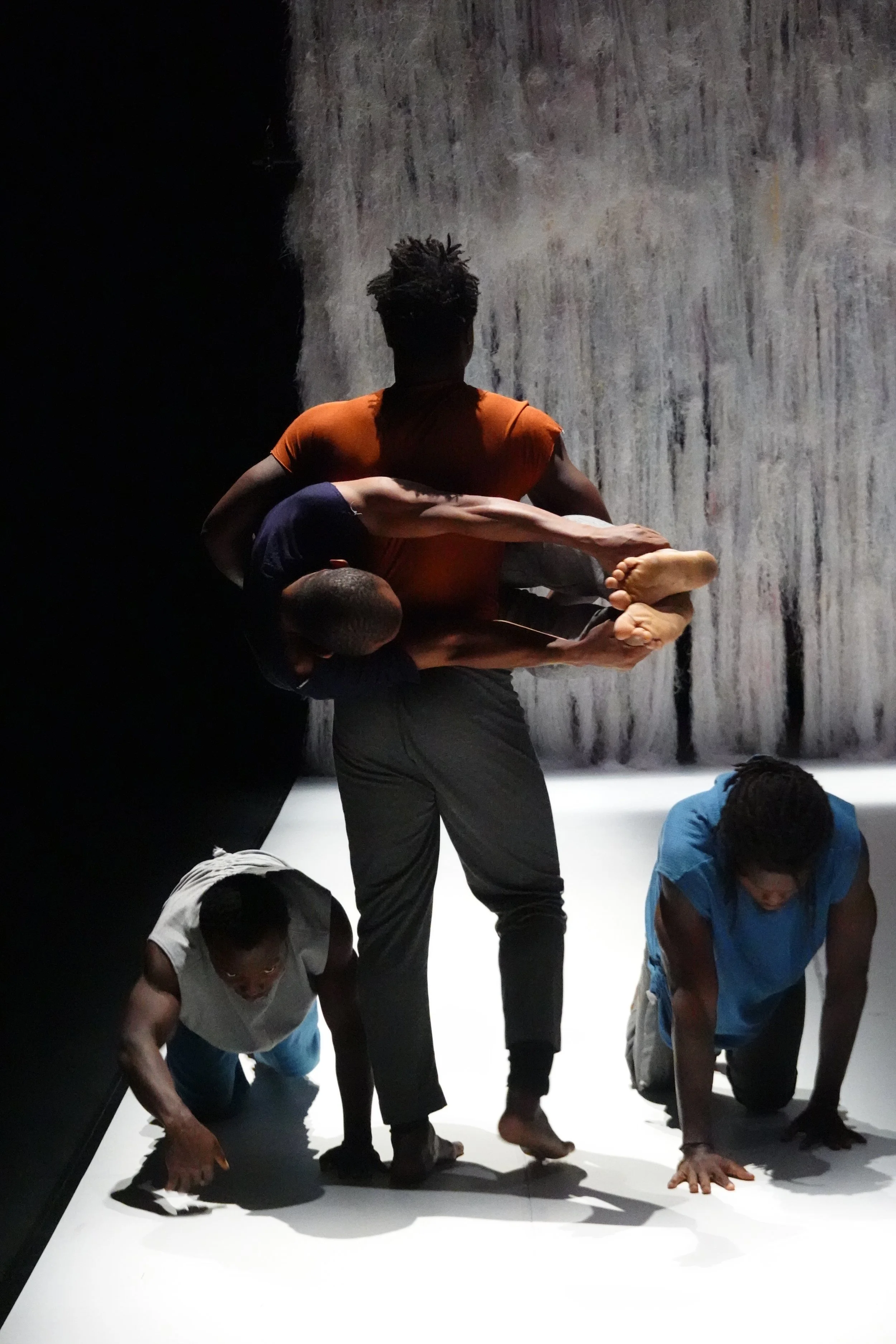
Dance Center Artistic Director Meredith Sutton sat down with choreographer and dancer Marcel Gbeffa to talk about the perspectives, traditions and lineage that he and collaborator Sarah Trouche drew upon to create Didę coming to the Dance Center for one-night-only on April 24, 2026 as part of Compagnie Multicorps’ first U.S. tour.
Meredith: Let’s start with what is the meaning of the word didę?
Marcel: Didę [pronounced deeDAY] means stand up, stay strong, don’t sit down, keep going. You have to wake up, it’s time to go.
Meredith: It sounds like a call to action, like a cry—here we are, let's keep advancing forward.
Marcel: That’s it. It comes from Yoruba from the Western coast of Africa: Benin, Togo, Nigeria. Didę is talking to the men to stand up. In the Yoruba culture, we have the Gèlèdè ceremonies—this god is a woman, the mother of creation, and men recognize that they do many bad things to women. In this ceremony, men celebrate the mother of creation and ask her to forgive them, they recognize woman’s power. On ceremony days, the men, they are helpful, they are good with women. Inside the ceremonies, the dance they do, it's also to glorify, to ask to this god to give them more energy to have more of a good relationship in the society. The idea for didę, it's not just the three days of the ceremony. We have to keep a good relationship and understand the power of women in society, how we can live together. It's not easy to defend women’s rights because the system and other men make it really hard. The idea of didę, it's to ask the god of creation, a woman, for the power to resist and to keep going, to stand up, to make change.
Meredith: What reverence or responsibilities do you feel, Marcel, in handling something so rooted in tradition when drawing from these Gèlèdè traditions in the creation of Didę?
Didę, photo by Sarah Trouche.
Marcel: These are all influences from where I live, from my roots and culture. It’s normal for me to create with what is around me. Because the art, and what we call the tradition, it’s all the time changing. For me to use the Gèlèdè mask structure, it's to bring another idea within an aesthetic which can still connect to our roots, but find some universal connection in the world. My responsibility is to show that we have different possibilities to use our traditions. Most of the time, our masks were not considered art but when you see Picasso you see that he used different masks from Congo. And when they say the African didn’t have writing, and you see Louis Vuitton, the symbols they rely on, all those things come from some place. They are using all those things to create something original. I think we, as Africans, have more legitimacy to use them to create another thing.
Meredith: Can you talk about points of collaboration with Sarah Trouche and the development of these beautiful masks that are utilized in multifaceted ways within the work? How did that inform your developing the movement vocabulary?
Marcel: In 2008, the French Institute put us in connection. It was good to meet someone who comes from performance and who also knows about visual art to collaborate about this subject, about gender – Sarah uses her body to protest and to find a way to defend the artist; I'm a dancer and sometimes it's difficult to be a male dancer – to talk about why do we have to think that these activities have to be for men or women. It's where we start to work. We talk about the resistance – how men, how the body resist. It’s why in the piece, you have many, many parts where you have people fall and stand up, fall and stand up. Inside this resistance, they find also the way, the energy of the divinity to stand up. We talk about the energy, about the mask Gèlèdè, all those energies connected to Mami Wata, the rainbow divinities, the water divinities, the snake, all those things connected to fluidity. It is why Sarah decided to draw the head of the mask circular. Sébastien Boko made all the shapes following the drawings of Sarah.
Meredith: I see. From her drawings and the collaborative ideas that you generated together, someone else fabricated the masks. Why is that?
Marcel: Because it can be an appropriation - there is a specific way to cut this wood. Most of the people who cut this wood, I think there are four families in Benin, and all those artists come from those families. They have the specific way to cut. You cut everything. You don't cut and after paste. Everything is one piece.
Meredith: What type of wood is utilized?
Marcel: There is some specific wood we call Iroko, it's connected to divinity spirit. They use it specifically for some ceremonies. This is what Sébastien made the masks with.

Image courtesy of Marcel Gbeffa, photo by Maurine Tric.
Meredith: The specificity of the use of space is also very clear.
Marcel: The piece, it's just an open parenthesis. In Benin, when we do some ceremonies, we don't do it in the box, we do it in the open space in the field. You have the audience who can applaud, who can play, who can enjoy, who can sing with the drummers and all those people who are doing the ceremonies. I try to turn my work like that, to make the audience to be part of process. When they open the door, the people, the audience make a tour and go to sit. It’s to prepare the space for what will happen.
Meredith: That's beautiful. What does it mean to share this work with different communities throughout the world?
Marcel: We showed the piece in Paris three times, we showed it in Mozambique, Togo, Benin, Mali, and now we are coming to the U.S., Senegal, and Colombia. For me, what is really important, it’s to let people notice that there is another kind of vocabulary of creation in another part of the world. Today we are in the globalization and we have some voice. We have something also we have to talk about and the people have to see. And that's it, that is us at this moment. Maybe in three days it will change. But to share this piece is to let people know that there are the same problems in different communities and we have also some connection. So talk about women’s rights, LGBTQ rights, talk about politics, talk about conservation, talk about your own roots, all those things. I think all nations, all countries have the same things to talk about. And we want to let people know that there is another thing happening in Africa. It's not just the same choreographer you already know, but there is also a young generation, other artists, they can meet, they can discover.
Meredith: Absolutely! Thank you very much. I really appreciate the time and the beautiful articulation of these thoughts and ideas and an inside look into the process.
The Midwest premiere of Didę is supported by FUSED, a program of Villa Albertine and Albertine Foundation, and is in partnership with Lehigh University’s Zoellner Arts Center, The Conservatory of Dance at Purchase College, State University of New York, and the Hearst Fellowship Residency at Princeton University.
For more information, please contact Stephanie Tooman, U.S. Representative and Program Coordinator for Compagnie Multicorps, via email at stephanietooman5@gmail.com.
