Information for Panelists for
The Shirley Mordine Dance Maker Award
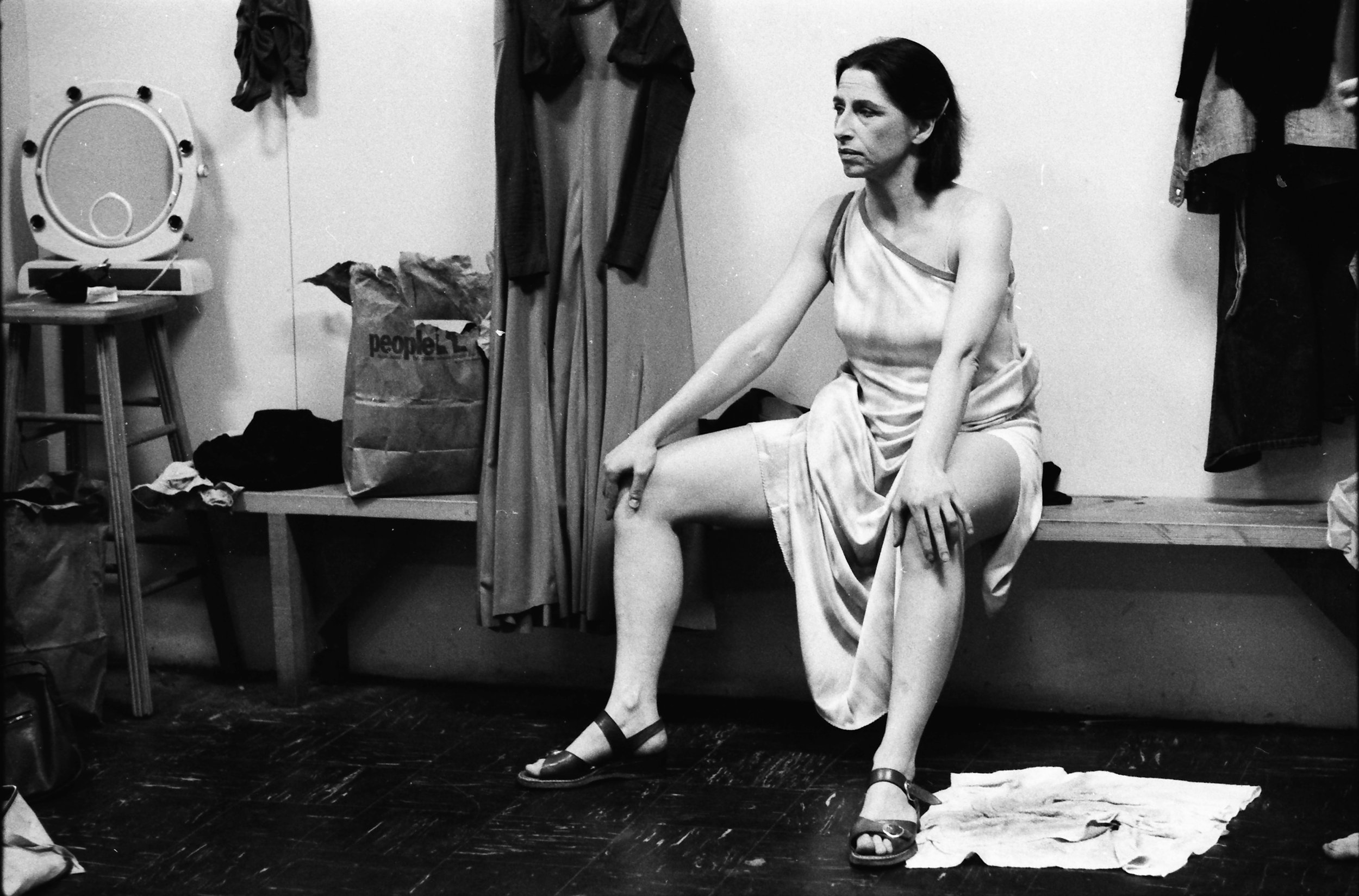
pictured: Shirley Mordine seated in a dressinig room with one hand on each knee, staring into the distance deep in thought.
Widely considered to be the founder of contemporary Modern dance in Chicago, Shirley Mordine was a visionary dancer, performer, choreographer, and educator. Her five-decade career in Chicago included founding the Dance Department at Columbia College Chicago, the Dance Center of Columbia College Chicago, and originating the college’s revered Dance Presenting Series. A prolific artist, Shirley founded and served as Artistic Director of Mordine & Company Dance Theater from 1969 to 2019. Her contributions sparked and encouraged a vibrant, enduring Chicago dance community.
As a living legacy to honor Shirley Mordine’s dedication and prolific contribution to Chicago and contemporary dance, and her prodigious and life-long love of dance making, the Award is a $1,000 cash grant plus mentorship support for early-to-mid career Chicago choreographers.
An awarded choreographer may use their cash grant for any purpose that furthers their dancemaking and are expected to produce a new choreographic work within 12 months of receiving the Award.
The panel will select two choreographers to each receive The Shirley Mordine Dance Maker Award in December 2026.
Criteria for Panelists to Consider
“Every dance should be new, strange & beautiful.” – Shirley Mordine
Shirley Mordine never stopped exploring, inquiring, or innovating in her more than five decades making dances. At the 50th anniversary concerts of Mordine & Company Dance Theater in 2019, an audience member shared: “This is not someone resting on her laurels or coasting. This is a dancemaker who has never stopped pushing boundaries.”
Please review your assigned pool of applications with Shirley’s approach to dancemaking in mind:
Is the applicant making explorative/inquisitive work? If yes, how?
Are you excited to see the applicant’s proposed work come to life? If yes, why?
In addition, keep in mind the mission and values of the Dance Center of Columbia College Chicago during the selection process:
The Dance Center of Columbia College Chicago values embodied human expression and nurtures an expansive understanding of dance from the established to the experimental. Centering pluralism, the Dance Center aims to be a nucleus for innovation and creativity—on stage, in the classroom, and beyond. We cultivate an environment and culture that prioritizes respect for self and others, and advances an anti-racist, equitable, and just society.
Panel roles and responsibilities
Read and assess every application assigned to you. (Note: you will have access to every application and are welcome, but not required, to review them all.)
Be open to a range of choreographic processes and how artists communicate them.
Fill out short form answers for each assigned application:
Is the applicant making explorative/inquisitive work? If yes, how
Are you excited to see the applicant’s proposed work come to life? If yes, why?
Assess each assigned application using the following rubric:
On a scale of 1 to 4:
1 (I have serious doubts)
2 (I think maybe with additional supports)
3 (I think definitely with additional supports)
4 (YES)
A. Artist’s Readiness – does the application suggest that the artist is ready to bring this work to life?
B. Project Scope – do you think the work can come to fruition as described in the application?
C. Artistic Risk – does the work feel like it will stretch the artist in healthy ways?
D. Spark – do you think this artist is tenacious and driven to innovate through dance making for the foreseeable future?
Note: Applicants who request feedback on their proposal will receive an anonymized version of the panelist’s written assessment sent to them via email by the Dance Center of Columbia College Chicago.
Propose three of your assigned applicants for consideration for The Shirley Mordine Dance Maker Award. (Every application selected by panelists will be flagged for review in advance of the group discussion.)
During group discussion:
Present your recommended assigned applicants.
Actively listen to others’ proposals and perspectives.
Express your own thoughts and perspectives.
Come to consensus on who will receive The Award(s).
Accept decision reached collectively.
Conflict(s) of Interest
Panelists are obligated to let the Dance Center of Columbia College Chicago know of any relationship you have with any of your assigned applicants so they can be re-assigned. (Examples of relationships include: family or relation, affiliated with your current artistic practice/organization/company, someone you have presented/performed with over the past four years, anyone you are or have been financially involved with, etc.)
This is not suggesting you cannot be objective. This is to ensure the decision of the panel does not appear pre-determined or influenced by close personal or financial ties.
If any applicants are recommended for group discussion that you have a conflict of interest with, you will be recused from the group discussion of the applicant(s). Your departure will be noted in the minutes and you will wait in a Teams waiting room for the duration of the discussion of the applicant(s).
