What Is Contemporary? Symposium 2025 Recap
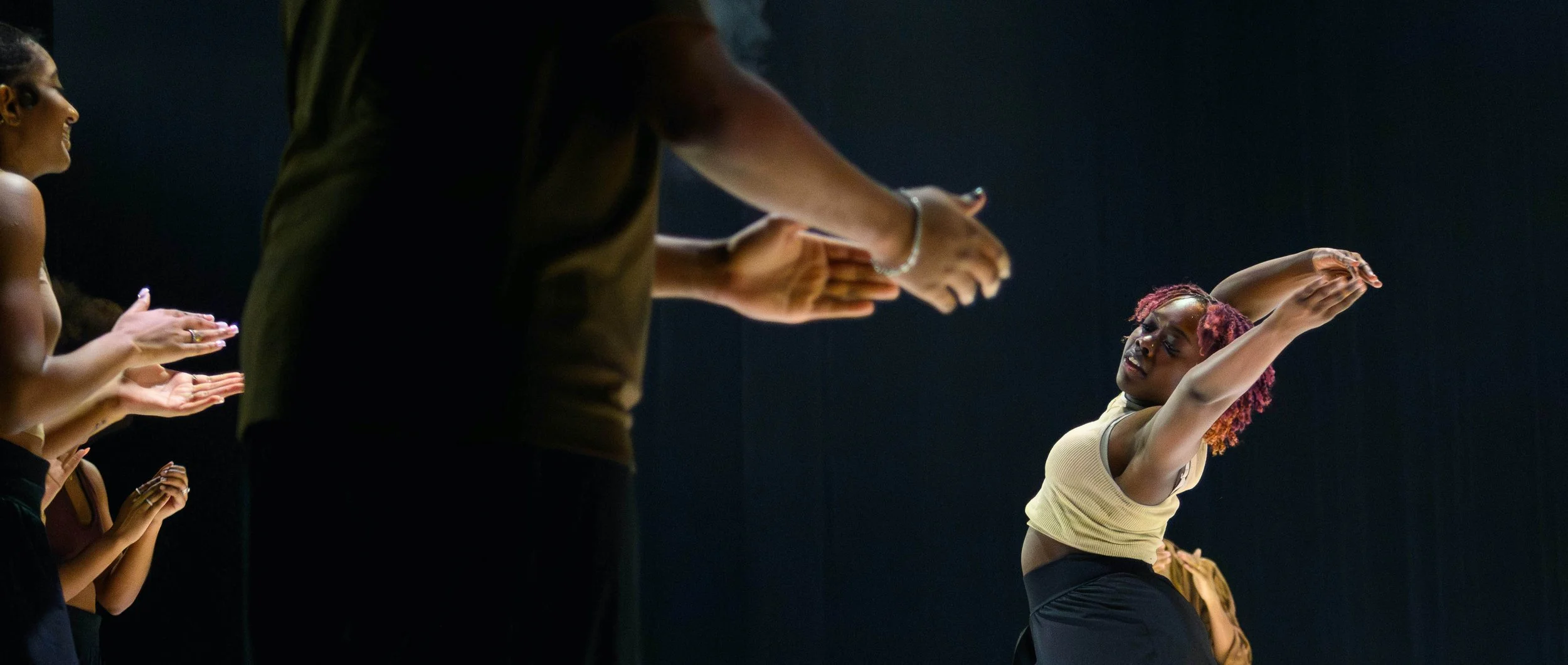
The dancers of Visceral Dance Chicago stand on stage, feet in parallel, staring into the audience while the stage light shadows the dancers as it passes from right to left. The performance begins, and the dancers move with intensity in harmony with the ambient music. Suddenly, the music shifts to hard-hitting, disco beats, and the dark, intense vibe becomes playful or almost sensual. The dancers keep the balletic structure in their dancing and movement, but there is an added spark; there's a flirty look; there's joy; there's fun amongst the technical movement. Is contemporary a blending of technical dance, like ballet, and more modern ideas of music, costuming, and lighting?
Dr. Ayo Walker sits on stage as she discusses the harms with the idea of contemporary hip-hop, asserting that hip-hop performance needs dancers who have truly trained and studied in the hip- hop diaspora. This blending of styles in the guise of producing something new can produce something offensive to the practitioners of hip-hop and the traditions of hip-hop culture. Is contemporary an entryway for cultural appropriation and a disservice to a codified method of dance?
On Zoom across the world in a different time zone, Giulia Cristofoli lectures about her research as a dramaturge in Misiconi’s 2024 production of Falling – a multidisciplinary choreographic experiment with dancers with and without disabilities. Her observations center around CRIP TIME (a phenomenon that recognizes how people with disabilities experience time differently) and the infrastructures that impose certain timeframes around day-to-day activities. Is contemporary both inclusion/recognition, and de-hierarchization of ableist structures?
What Is Contemporary? Symposium 2025, hosted by the Dance Center of Columbia College Chicago, explored the idea of ‘contemporary’ and the many meanings it takes on in reference to dance. The conference acknowledged that the word contemporary has a definitive meaning - ‘belonging to or happening now’ – while also recognizing that when paired with the word ‘dance’ (i.e., contemporary dance), takes on vastly different definitions from artist to artist. In this three-day symposium, dancers, academics, and professionals in the dance field contemplated this word contemporary – and in term contemporary dance – to not define it, but to understand what the complexity of the word means for the dance industry.
DAY 1: MOMENT + MOVEMENT PERFORMANCE SHOWCASE
Performances by Visceral Dance Chicago, Zachary Nicol, and Ensemble Español Spanish Dance Theater
The symposium begins with an evening of performances by three dance companies that define their movement styling as contemporary. Visceral Dance Chicago performs “Pearl” by Nick Pupillo, a piece that was both technical and playful, emphasizing the artist’s versatility and strong physical capability. While the night faced several technical difficulties, the pauses became contemporary by breaking the barrier between performer and audience. The audience became more enthusiastic while the dancers loosened up more, knowing that the audience was cheering them on. The next piece, “In Counter” by Zachary Nicol, was a beautiful solo that incorporated projected visuals and profound theatrical light changes. The repeated phrase of “I tried” cloaks the performance with a sense of despair, and the soloist’s ever-changing environment, paired with slow, subtle movements, pictures a human burdened with the uncertainty of life. The last set of performances by Ensemble Español Spanish Dance Theater livens the stage with a contemporary take on flamenco dance. I had the opportunity to speak with one of the choreographers, María Lujan, who defines her work as contemporary not only through the movement but through the costuming. She explains how ruffles on a dress reflect traditions of Spain, and the dancer’s removal of those essential pieces makes for a more modern take on flamenco traditions.
DAY 2: DAY OF SESSIONS
Session 1: Living Rituals
What is Contemporary Dance, and How Might It Guide Us Back to Nature? | Nejla Yatkin – embodied workshop & Rehearsing the contemporary: from history to now and back again | Michael Landez (Northwestern University) – paper presentation
The day begins with Nejla Yatkin’s embodied workshop that questions the notion of contemporary dance through active movement. We stand in a large circle and move, leading with our breath, through Nejla’s patterned sequence: curves, circles, waves, lines, and spirals. She sees contemporary not as a technique but as a way of being, an honoring of remembrance, and a tool for discovery. Michael Landez’s presentation contemplates contemporary by examining the rehearsal process and how that process questions the authority of performance. He defines the act of taking the authority of what is seen and what is not seen out of the audience’s hands and into the artist’s hands as contemporary. The rehearsal for the artist is contemporary (now, of this time), and the performance becomes a remembrance of the past, something that only the artist has the full context to refer back to.
Session 2: Lineage + Rupture + Return
Spirals of Cultural Mobility: Contemporary Dance as Cultural Exchange | Timothy Tsang (University of Michigan) – embodied workshop & Vessel 03: Translated Vase | Irene Hsiao – screening and discussion
Session 2 begins with an embodied workshop by Timothy Tsang, where he leads a class with various forms of movements that define who he is as a queer, Chinese-American artist. He views contemporary through the framework of multiplicity, showing how Tai Chi, modern, house, and vogue dance shape his movement vocabulary. The same way multiple cultures guide who he is as a person is the same way multiple forms of dance define who he is as an artist. Irene Hsiao’s screening of Vessel 03: Translated Vase considers contemporary as an intermingling of movement and technology, reflecting technology’s impact today. The segmented editing style showing two dancers intertwined and indiscriminate, broken pieces of pottery being put together, shows how technology can aid in storytelling in ways other than through live performance.
Session 3: Creative Access
Contemporary dance aesthetics within crip time framework: a dramaturge’s perspective | Giulia Cristofoli – paper presentation
Giulia Cristofoli’s virtual presentation on crip time and desynchronization acknowledges contemporary as a form of equity and inclusion, paving the way for performance work that recognizes the experiences of people with and without disabilities. Documenting her experiences as a dramaturge in Misiconi’s 7-month rehearsal process for the 2024 production of Falling, she explains how she helped in the creation of this piece that was a reflection of people’s experiences with disabilities without being considered a subsection of disability work. This work contemplates ableist impositions of time and acknowledges that not all people can abide by the same time constraints.
Session 4: Context + Impact
Body Language | Maya Odim – workshop and Memory Fleet: All of them | Jasmine Hearn lecture/demonstration
The Body Language workshop sees contemporary as a new approach to movement generation. In Maya Odim’s workshop, dancers were invited to create poems and make short solos based on the words they wrote that compelled movement. Through Maya’s research on synchronization of dance and text, contemporary becomes a means for creative movement generation tactics through connection to other art forms. Jasmine Hearn’s solo, based on memory, sees contemporary as a means for circulating impactful history and experiences. Her emphasis on gratitude, paired with cultural awareness and historical impact, made for a beautiful performance of strong, gestural movement that is contemporary in its tender performance.
Session 5: Centering + Reframing
Centering Lived Experiences: A Somatic Approach to Contemporary Dance and Movement Practice | Elizabeth Shea (University of Indiana) – embodied workshop & Recovering Doris Humphrey: Disability as Method in Dance History & Technique | Maggie Bridger (University of Illinois-Chicago) + Deborah Goodman (Loyola University) – paper presentation
Elizabeth Shea leads an embodied workshop where she uses descriptive and colorful language to teach short phrases of movement. Her emphasis on somatic practice within modern dance technique defines contemporary as a more holistic approach to teaching modern dance, accounting for the dancer’s overall well-being when teaching a technique class. Maggie Bridger and Deborah Goodman’s paper on Doris Humphrey complicates the idea of working through pain. Their paper uncovers how dismissal of pain harms disability inclusion in dance and sees contemporary as a means for making dance available for everybody.
Session 6: Representation + Resistance
Understanding the Misinterpretation of Contemporary Dance Styles as Street Dance | Dr. Ayo Walker (Columbia College Chicago + Rennie Harris University) – paper presentation and Non-Technical Movement Vocabularies, Innovation, and Embodied Resistance | Marquita De Jesus (University of Texas at Dallas) – embodied workshop
Representation + Resistance starts with Dr. Ayo Walker’s lecture on the issues surrounding contemporary hip-hop as a codified form of dance. She resists the idea of innovation for innovation's sake and encourages artists who want to blend different forms of dance to find commonality without erasure. Marquita De Jesus’s embodied workshop recognizes contemporary dance as a framework for movement innovation, defining contemporary as a structure for shaping personal artistic movement and practice. She makes this distinction by leading an exercise where dancers stand in a circle and one soloist improvises while the circle becomes smaller. The dancer is confronted directly with who they are as a mover through the eyes of the observers in the circle and must conform to the ever-changing landscape of their space.
Session 7: Reshaping Now
Why labels matter: Interdependencies of universities and dance companies | Kate Mattingly (Old Dominion University) and Improvising Community: Building Ecosystems for Contemporary, Multidisciplinary Collaboration | Marie Casimir + Cristal Sabbagh + Joyce Lindsey – embodied workshop and lecture/demonstration
The day winds down with an examination of what contemporary means for dance in this moment in time. Kate Mattingly’s lecture on university/academia’s role in shaping dance in general leads her to define contemporary as a means to amplify uncertainty and continuously question what we as dancers do. By looking at the history of dance in university, we can shape how we define dance forms like contemporary going forward. The day of sessions ends with Cristal Sabbagh, curator and producer of Freedom From and Freedom To, and Marie Casimir, co-curator/co- producer of Instigation Festival, in collaboration with musician Joyce Lindsey, for a lecture and workshop on improvisation. Their examination of collaboration between musicians and artists in improvisational settings poses contemporary as a means for innovation for creativity in the moment. By curating these events with different artists each time, they are continuously creating something new through unpredictability.
DAY 3: ARTIST/SCHOLAR BRUNCH
My favorite part of the three-day event was the final artist/scholar brunch in the morning of the last day of the symposium. Presenters from the symposium, professors at Columbia College Chicago, and dancers from Visceral Dance Chicago gathered to synthesize their thoughts on contemporary after hearing all the unique perspectives presented. There was a consensus that the word contemporary itself reflects the ‘now’ while recognizing that the word is used interchangeably with ‘new’ or ‘innovative’. Many found issue with the general obsession in the dance world with creating something new, reflecting that everything that is being done has been done before. While many are trying to create or approach a process in a new way, really, they are more so doing something that has been done but in their own way. Throughout the discussion, contemporary was defined as an approach, an allowance of multiple styles, a means for safe dance practices that encourages longevity in performance, an individual repurposing of what has already happened, a way to innovate for the sake of monetary gain, and even as an excuse to avoid traditional dance training.
While we did not leave agreeing on what contemporary dance is, we did leave with consideration on how to ethically move forward, knowing that this genre of contemporary is not going anywhere. In our rehearsal processes, we can acknowledge those who inspire us; in our classrooms, we can emphasize training and safety for our dancers; in our personal practice, we can pull from all that we have learned and experienced; in our universities, we can continue to question our curriculums; and in our performances, we can develop our artistry through various means and mediums. The notion of contemporary dance – while undefinable and sometimes controversial – sparks passionate discussion, creates beautiful and creative performances, and invites people of all walks of life into the world of dance.
Kaleigh Dent is a Chicago-based dance artist, choreographer, and dance educator. She has danced for companies such as Joel Hall Dancers, Still Inspired, LOUD BODIES, and Identity Performing Arts, where she was a Company Member and Rehearsal Director for five seasons. She is currently a member of The Trüp, Fantasy Dance Team, and Sirens Revenge Performance, where her most recent performances include World of Dance Chicago and URBANITE Urbana-Champaign. As a second-year Master of Fine Arts in Dance candidate at the University of Wisconsin-Milwaukee, she researches the synthesizing and codifying of contemporary and hip-hop dance techniques. She graduated with a Bachelor of Fine Arts in Dance from the University of Illinois at Urbana-Champaign and is certified in the Cecchetti ballet teaching method by the Cecchetti Council of America.
