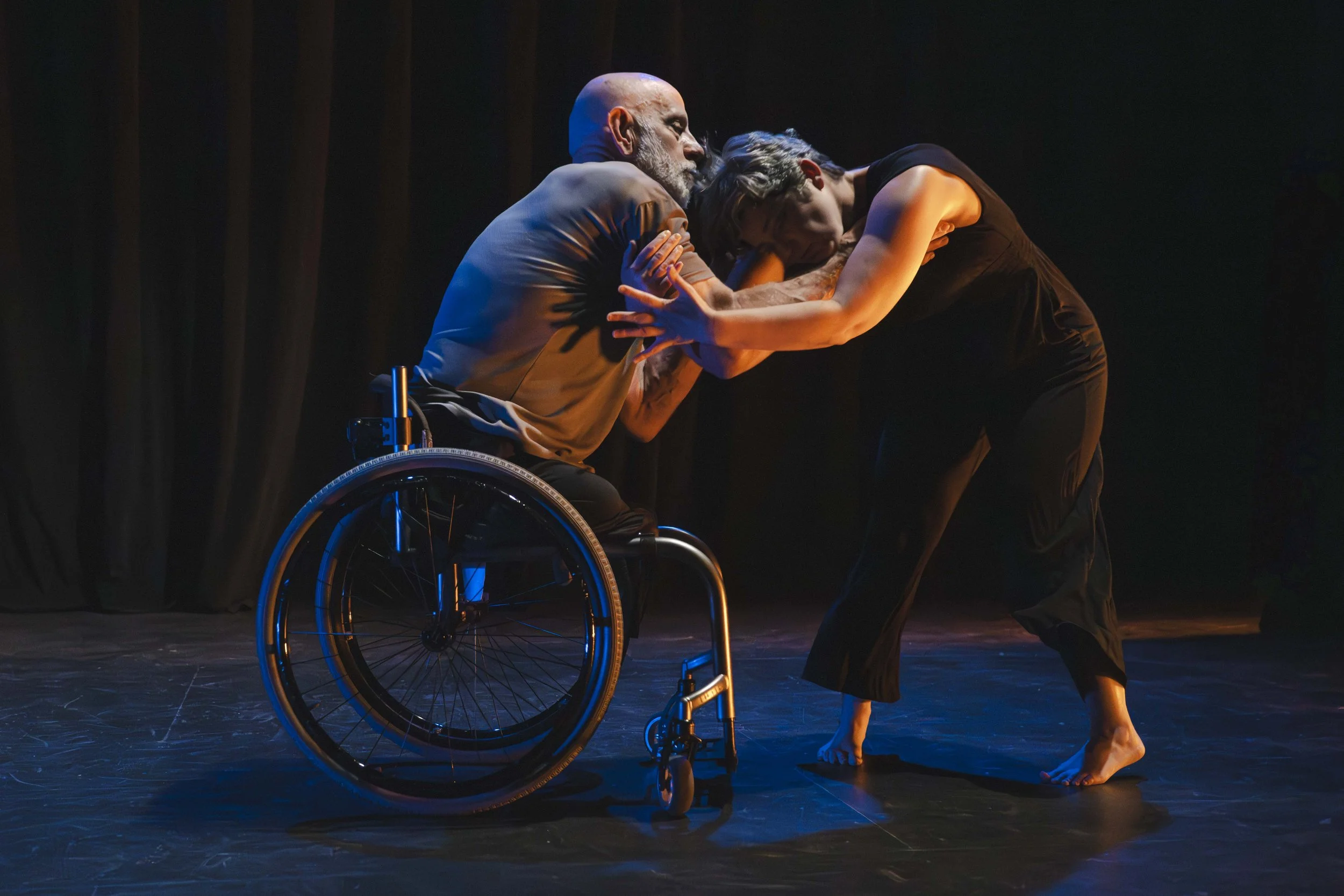
Artistic Director Meredith Sutton sat down with Maggie Bridger, Ginger Lane, and Sarah Najera to talk about the CounterBalance 15th Anniversary, Emerging Artist Showcase, and Inclusive Creative Movement Workshop as part of Season 53 of the Dance Presenting Series. The CounterBalance Anniversary program happens October 16; the Emerging Artists Showcase follows on October 17; and we will offer the Inclusive Creative Movement Workshop on October 15.
Meredith Sutton: Let’s talk about the legacy and evolution of CounterBalance and the changing landscape about what inclusive dance is and where it can still go. Ginger, you founded CounterBalance in response to misconceptions about people with disabilities, particularly dance artists. Now 15 years later, what do you think has changed and what do you think still needs to change?
Ginger Lane (CounterBalance Co-Founder/Emerging Artist Showcase Co-Curator): When we come together as disabled dancers, we not only share the language of dance, we share the language of disability. Over the last 15 years, we're like a family. Now that we feel that, it's time to make room for the next generation of dancers and encourage them. I never thought this would take off and that it was embraced by the disability arts community was wonderful. Initially, the idea of having this one performance came to me because I saw that we had had a consortium of disability arts and culture and why shouldn’t dance be included? I already knew dancers from MOMENTA, I was able to bring them in and, it's almost like Judy [Garland] and Mickey [Rooney] saying, “Let's put on a show and let's just try it for one night!” And then it took off. It’s important that we encourage dancers with disabilities. That had not been the case prior to my doing this and that's why this Emerging Artist Showcase is a great thing because we're saying we want you as choreographers, too. Do your work and we will support you in whatever way we can.
Meredith: Maggie, as co-curator of the Emerging Artist Showcase with Ginger, what feels particularly exciting about creating a platform for early career choreographers?
Maggie Bridger ‘11 (Co-Curator of the Emerging Artist Showcase): CounterBalance was one of my first shows out of undergrad. I showed up at Access Living and I went up to Ginger (in that way that young people are particularly good at) and showed her video from work that I created at Columbia. She was like “great, show it at CounterBalance in a couple of months” which was incredible to have this beautiful invitation into disability art and culture after just showing up in a space and being—I think I belong here. That spirit of affording a platform to people who are still figuring out what disability art is in their lives, or what disability identity is, or what their experience of disability is, was core to my understanding and to my personal experience of CounterBalance from the start. The Emerging Artist Showcase is building a space of community and mentorship for artists that are trying to navigate what it means to make dance as a disabled person.
Meredith: It seems really inspired by your own lived experience - what do you hope emerging, disabled choreographers find within this platform?
Maggie: The artists are excited to be together in a space where they don't have to explain why they're making this type of work or do the Disability 101 thing that disabled artists feel like they have to do. We don't often have a space where there are a bunch of us in a room interested in the same questions and trying to parse through this complicated and beautiful work that we're engaged in.
Meredith: Sarah, tell us about your approach to curating the CounterBalance 15th Anniversary Inclusive Dance Concert.
Sarah Najera (Curator of CounterBalance 15th Anniversary Inclusive Dance Concert/ MOMENTA Dance Company Artistic & Executive Director): This year is not a retrospective but a celebration of how far the performance has come. The first CounterBalance that Ginger produced was in a conference room in the office building of Access Living and then we performed in some wonderful theaters around Chicago. But this is the first time that CounterBalance is performing on a stage that's actually created for dance. What an exciting accomplishment! MOMENTA expanded its mission to be inclusive of artists with disabilities in 2003. Over two decades, I think that we have gotten better and better at physically integrated and inclusive dance, understanding that it’s best to start from the point of view of the dancer with disabilities and then non-disabled dancers translate movement into their body from the strengths of the disabled dancers. That was my point of view and what I wanted to show in this 15th anniversary. To Ginger's point, we do need more choreographers with disabilities which is why I'm so thrilled that we are partnering with Maggie and Ginger for this Emerging Artist Showcase. Another thing in terms of growth, 35 artists are part of the event and 18 of them identify as dancers with disabilities so that's pretty impressive.
Ginger: For the initial performance, I didn’t even call it CounterBalance, but Off-Balance because it sounded a little quirky. I asked Alana Wallace, Anita Fillmore Kenny, and Kris Lenzo if they would perform. They did, and it was the first time a dancer who had a disability (Alana and I were both disabled choreographers) choreographed a piece rather than just be in a piece. This was a huge step, even for a company like Axis Dance company, the premier US disability dance company. They hired mainstream choreographers and included the dancers with disabilities in their works, but not as choreographers. This is important because inclusive dance is part of the disability culture movement, which recognizes and celebrates the first-person experience of disability. It is in line with and promotes a disability aesthetic, and is a model of legacy making that is embodied and intergenerational. To quote Maggie in one of her writings, “disability dance is a complex network of embodied, cultural knowledge.” Being able to perform at the Dance Center is next level since it is a venue specifically designed for dance. The first places that I performed, you couldn't even get into the theater. We were allowed to be audience and they’d make a little space for us, but we couldn't get on the stage and we weren't at the table. Initially Stephanie Clemens and I as co-artistic directors both had things that we wanted to bring and we were equal partners. It was never intended to be a disability only kind of performance. It was always a combination of dancers with and dancers without disabilities joining forces.
Meredith: Accessibility measures and accommodations are so thoughtfully woven into every single aspect of what CounterBalance does and what will be shared at the Dance Center. How do you think about accessibility as not simply being an accommodation but part of the creative experience and artistic practice? What are your collective thoughts on this?
Ginger: You just hit it, Meredith. It’s not only accommodation. I come from a classical ballet background and so initially I was trying to emulate what I had done before I became disabled. My initial north star was someone like Margot Fonteyn. I couldn't do that anymore and what emerged was that what I could do things that disabled dancers could do and that was just as valuable. The biggest take away was trial and error. A great example is I once choreographed on Chris Lenzo and he's got incredibly long arms and I was trying to get him to use his arms like a swan. Well, he's a big athletic guy and it finally occurred to me that I needed to choreograph on him in terms of what he is able to do and what he brings to it. It was his own personality. That realization was a big step forward for me in terms of the collaboration of the two elements of dance disability and mainstream and what each could bring to the table. Many dancers have felt their disabilities were being used rather than being valued as dancers themselves.
Sarah: We have a dancer that when dancing with another company in rehearsal she thought, “Do you need me or do you just need my chair?” That's really stuck with me because a lot of MOMENTA’s choreographers do not have disabilities so we have incorporated disability awareness training into our artist process. The wheelchair is not a prop. It is an extension of that dancer. Choreographers should always consider, “Am I treating this dancer the way that they should fully be ,or am I engaging in some ableist practices because my lived experience is not as a disabled person?” That’s where collaboration comes in between dancers and choreographers. Also, it means a lot when we can perform at accessible places like the Dance Center where ALL of our dancers can come in the front door together, and be in all of the spaces backstage together.
Ginger: When we started, it was just non-disabled dancers and dancers in wheelchairs. But incorporating dancers with other disabilities is critical to a well-rounded integration.
Maggie: I want to circle back to your question about access, Meredith. Access is a really essential part of the creative process. When Sarah's considering movement patterns, that's an access skill. Access is a practice, in and of itself, and an artistic method. I think that's a fascinating and exciting thing that's happening in the disability community. Ginger is suggesting that we think about access and disability in much broader and more expansive ways, rather than creating a simple division between disabled and non-disabled people, such as wheelchair users and people who dance on their feet. Instead, we can consider the many different experiences people bring as they enter a rehearsal studio, classroom, performance, or tech space. Each of these environments offers an opportunity to think more creatively about how people grow up, how they are invited into a space, and how their individual needs and experiences are considered. The goal is to attend thoughtfully to a broad range of experiences from the very beginning, building access and inclusion into the conception of the artistic process rather than adding them afterward.
Meredith: Thank you so much for that, and for the collective response to this idea that accessibility is something that should be fully considered and standardized within the artistic process itself.
Sarah: There's a lot of things even within the rehearsal process I consider access features. Beyond ensuring a space is wheelchair accessible, there needs to be understanding of and a willingness to meet the needs of every dancer for each rehearsal. For example, a dancer may request a mat to rest on when feeling tired. We have found that the rehearsal process for someone with intellectual disabilities is successful when we make a plan and stick to it so dancers understand what to expect each day. When we have a Deaf dancer, we hire an ASL interpreter to attend all rehearsals and performances. We work with dancers with all types of disabilities and we do our best to communicate throughout the entire rehearsal process so everyone feels welcome, safe, and free to do their best work.
Meredith: What do you hope CounterBalance continues to make possible for dance itself?
Sarah: I hope that MOMENTA can continue to challenge audiences' preconceived notions about disability. Through CounterBalance, we can use dance as a tool for disability awareness. Our artists with disabilities should be acknowledged and celebrated. They are making extraordinary contributions to dance because of their disability. CounterBalance showcases physically-integrated/inclusive dance as its own genre and an important art form.
Ginger: My hope for the future is it continues to grow and expand for wider audiences. I hope that an audience isn't saying, it’s nice that people who have disabilities are up there on stage, but that it's a given. In any dance performance or concert you should experience different types of dancers and different types of choreography. It can be viewed and judged on its own merits by audiences exposed to a variety of different viewpoints and perspectives. Alice Sheppard choreographed a piece that both Sarah and I were in. Mainstream dancers count to eight and she was having us do some turns. I kept saying, “I can't get around by the count of eight,” and she said, “That's OK – you get around in the time it takes you in that chair to be able to complete the turn.” What was important to her was the feeling of spinning and that helped me to understand as a choreographer my expectation should be that you're creating work where each person may be doing something slightly different, or to a different count, but it all comes together.
Maggie: In a lot of ways, the Emerging Artist Showcase encapsulates my hopes for CounterBalance in the future - the opportunity to bring together a broad range of artists all doing such different and incredibly beautiful work. They are exploring disability and dance in ways that are different from what we've seen in CounterBalance which I find extraordinarily exciting. That speaks to the broad range of organizing and artistic development that things like CounterBalance have made possible in Chicago. Ginger mentored me into this space and now she’s partnering with me to mentor this other group of artists. That feels like a culmination and also a moment where we're making real the promise of that original CounterBalance. As an alum, I can't help but think about how much it would have meant to me to have something like this on stage when I was a student. It would have changed my life to have disabled people in the halls at Columbia, leading workshops, people openly identifying and talking and moving in disability art and culture. That feels incredible to come back now with this program and community and to have a leadership role in in making that happen.
Meredith: With both a 15-year milestone and the launch of the new Emerging Artist Showcase, this celebration seems to me to be about ongoing-ness and how we can meet kinesthetically, energetically, and dynamically in space together. What I’m receiving from all of you is the genuine value that emerges when there is convergence of different bodies, abilities, perspectives, and ways of moving. There’s an unfolding of possibilities that simply can’t be anticipated or prescribed. It’s a kind of inspired innovation that emerges organically. It’s spontaneous, unexpected, and incredibly exciting. Thank you!
Banner photo above: photo by A. Deran Photography
