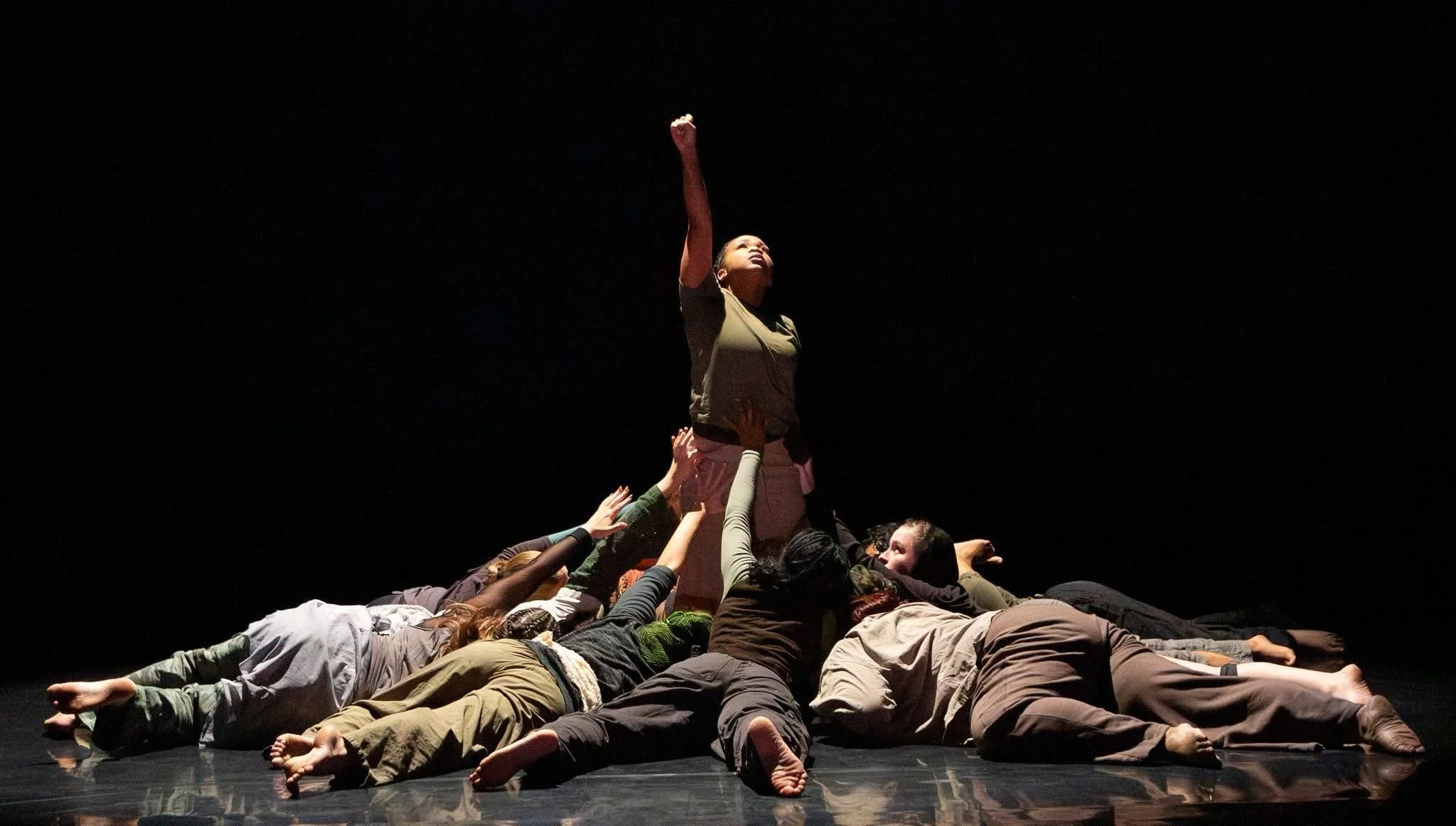
Sharon Hoyer of New City Stage speaks with Bevara Anderson-Selkridge about BALA Dance Project’s debut at the Dance Center of Columbia College Chicago.
…The Columbia College professor has, over the years, gathered an intimately collaborative group of dancers grounded in Umfundalai, the contemporary African dance style that most profoundly informs her work. When she moved to Chicago after her graduate program at University of Illinois Urbana-Champaign, several dancers who studied with her followed. These and two-dozen more current and former Columbia College dancers join a group that will perform at the Dance Center October 23 and 24 in “Essence,” the first evening-length presentation by Anderson-Selkridge’s company BALA Dance Project.
The company name derives from Anderson-Selkridge’s initials, which come from her two grandmothers, Beverly Ann and Barbara Ann. The quiet thoughtfulness with which she volunteers this information is inflected throughout our interview—in her descriptions of the formation and evolution of her company, a calm that resonates even in her reflections on how making art as a Black woman in America is an act of resistance. It’s a demeanor that may well carry the influence of Dr. Kariamu Welsh, the creator of Umfundalai (which translates to “essential” in Kiswahili) and Anderson-Selkridge’s teacher in her undergrad program at Temple University…
Anderson-Selkridge describes her approach to choreography, which is informed by house and Umfundalai, as it is by ballet, Horton and other contemporary techniques and vocabularies. The performance at the Dance Center will include six pieces and “The Balm of Joy,” a short film Anderson-Selkridge created at the end of her graduate program…
When I ask Anderson-Selkridge about her statement that making art is an act of resistance, she says it comes out of conversations she has had with other artists of color and “the necessity to keep making in a space where we feel like we have just enough energy to survive. I think making work as a Black woman and continuing to be in a creative space is an act of resistance in a world that is trying to make me so exhausted and without capacity that I have no room to have anything to just make it to the next day,” she says. “The mental load of all the things in life—it makes you feel that making isn’t important or worthy enough. So, to shut that noise out and say no, I’m going to keep dancing, we’re going to keep researching and creating and loving and showing is an act of resistance. I will not be hidden. The dancers I’m working with will not be hidden.”
Banner image above: pictured Courtney Cooper (standing) surrounded by Milenka Aurelio, Grace Butt, Sophie Daker, Nia Durlacher, Lizeth Hernandez, Erica Jones, Shannon Lane, Sawyer Latimore, Sophia Peck, Areli Ramirez, CJ Triche, Diamond Turner, Mikaylah Williams, Ava-C. Winfrey; photo by William Frederking.
